Showing posts with label Bad Gastein. Show all posts

Thursday, March 17, 2016

We're Out of Copper, But How About a Zirconium Bracelet?

Among the cruelest deceptions perpetrated upon people by other people are those having to do with phony medical aids, sham healing potions, "miracle" cures, and other forms of snake oil. It just seems to be my nature to suspect the worst when even the most trustworthy appearing people suggest to me some "cure" that has somehow been overlooked by pharmaceutical manufacturers who spend a few billion dollars a year on research - but is well known to granny and the girls working down in the lingerie department. This isn't to say that it doesn't happen, but these "cures" are certainly suspect from the start with me. And so it was when I first heard about the "Free Enterprise Mine" and its claim to have a beneficial effect on arthritis, bursitis, and a dozen or so other debilitating conditions.

For starters, I didn't like the name. Not because I don't like the free-enterprise system, but because I do. It seemed to me that charlatans might be using a good name to disguise another of those despicable medical deceptions. This was early in my attempt at writing this book - and I didn't think any more about it for several months. By then I knew about the high radon content of many European spas and those at Bad Gastein in particular. To me, these resorts, which compete for having the highest radiation level, just showed that our fears of radon and low-level radiation were what I had already suspected: contrived and ridiculous.

What I didn't know was that the major "cures" offered by such health resorts ad the "Thermal Galleries" (a former gold mine and only one of the many spas in the Bad Gastein area) were for "rheumatic, arthritic and scoliotic disease." What was described in their advertisements was much like what I had heard about the Free Enterprise Mine, with one big difference: The spas had a two-thousand year history of arthritics coming there for relief. Still, the placebo effect and mass hypnosis didn't start with the twentieth century. I don't enjoy being fooled, and what's more, I didn't plan to be a shill for anyone bent on fooling others. Skepticism reigned.

Only very recently did I learn of the Japanese research on the hormonal reactions to inhalation of radon. (The test animals in these experiments were rabbits rather than mice.) As shown in Figure 31, there were marked increases in both beta-endorphins and m-enkephalins in the test animals. Those who know about such things claim that the former is a pain reliever, while the latter hormone creates a feeling of well-being.

Source for Figure 31 Effect of Radon Inhalation on Hormones: Yamaoka, K., Komoto, Y., Suzuka, I., Edamatsu, R., Mori, A., Effects of radon inhalation on biological function - lipid peroxide level, superoxide dismutase activity, and membrane fluidity. Arch Biochem Biophys. 1993 Apr; 302(1):37-41.

It dawned on me that I now had evidence from three continents leading to the same conclusion: that radon inhalation has a positive effect on arthritic diseases.

I remembered that someone had sent me a book on the Free Enterprise Mine, which I had carefully filed in the "probably won't need this" box. The name of the book was Arthritis and Radioactivity, by Wade V. Lewis, the original owner of the mine. [Available from Free Enterprise Mine, P.O. Box 67, Boulder, MT 59632. Email: hlthmine@mt.net.]

I learned that it didn't start out as any kind of treatment facility, but as a uranium mine in 1949. By chance, the wife of a visiting engineer went down in the mine with him and found to her amazement that her debilitating arthritic condition had improved. She convinced a friend in similar circumstances to return with her to see if this was "for real." Apparently it was, as the mine has flourished ever since.

The best thing about the book is its tone. It is not written in a "This is the way it is" and "This is what's happening" manner. It's more like "This is the way it appears" and "Perhaps this is the cause." The author, who died in 1974, was not a scientist but had learned a great deal about radiation and was trying to put the pieces together. If only he had had Luckey and Pollycove around at the time, it's no telling what the trio could have accomplished.

On August 27, 1999, there were a number of scientists on the way to a "Nuclear Technology - Bridging the Millennia" conference in Jackson, Wyoming. Among the speakers was Sadao Hattori, a Ph.D. in nuclear engineering who is vice-president and director of nuclear energy research at the Central Research Institute of the Electric Power Industry (CRIEPI) of Japan. Earlier, while compiling quotations from a large number of scientists (by which I hoped to show the depth of scientific criticism of the LNT and support for hormesis research), I ran across this 1996 quotation from the animated and dedicated "hormesian" [your author's first (and probably last) attempt at coining a word], Dr. Hattori:

"We [CRIEPI] are now carrying out experimental activities on the effects of low-dose radiation on mammals. After several years of research activities, we are recognizing Luckey's claim. Some basic surveys, including Hiroshima-Nagasaki survivors and animal experiments in Japan, have brought us exciting information on the health effects of low-dose radiation."

He went on to say that results for their research would be forthcoming. Let me tell you: Dr. Hattori delivers. In his paper delivered at the 1999 Boston conference of the American Nuclear Society, the nuclear scientist spoke on the following areas being explored by Japanese researchers:
1. Okumura's longevity of survivors exposed to low dose A-bomb radiation;
2. Sakamoto's non-Hodgkin's lymphoma successes;
3. Onishi's reports of enhancing the p53 tumor suppression gene;
4. An update on Mifune's Misasa Radon Spring study;
5. Yonezawa's research on Adaptive Response Windows;
6. Miyachi's work on stress moderation and pain relief;
7. Yamaoka's studies of hormonal and adrenaline increases.

There is one more study by Yamaoka with which an enterprising tabloid reporter could write his own ticket - if he could only understand a little science.

Yamaoka has found that radiation has a beneficial effect on cell membrane permeability, which in turn has a positive effect on the life of a particular cell. Stimulatory radiation equals high permeability, no wrinkles, no aging - and before this, relief from arthritis and related conditions. Rather interesting stories, wouldn't you say? Gee, I wonder where the reporters have gone.

Monday, March 7, 2016

Japan

Spring waters have often been found to have significant amounts of dissolved radon. This seems particularly true at springs that are considered "health spas," such as Bad Gastein in Austria, where the activity from radon and its progeny reaches 16,200 pCi/l - a mere 73,600% higher than the "contaminated milk" of such great concern to the media at Three Mile Island. A case in point are the radon springs at Misasa, Japan, where Mifune et al. [Mifune, M., et al. Cancer mortality survey in a spa area (Misasa, Japan) with a high radon background. Japan Journal of Cancer Research, 83, 1, 1992], investigated the prevalence of cancer mortality in Misasa versus that in the nearby town of Beppu Spring, a village with minimal waterborne radon. Also, used as a control, were the Standard Mortality Ratios for all Japan. Data were collected during the period 1952-88.

Caption for Figure 24: Japanese Mortality vs. Radon Prevalence: Mifune, M., Sobue, T., Arimoto, H., Komoto, Y., Kondo, S. and Tanooka, H. Cancer mortality survey in a spa area (Misasa, Japan) with a high radon background. Japan Journal of Cancer Research, 83, 5, 1992.

Stomach cancer mortality is singled out and plotted in Figure 24, since it might be expected from ingesting radon in the water. Obviously there is a significant negative correlation between radon exposure and cancer - in conflict with the LNT and in good agreement with hormesis expectations.

One unusual feature of the data concerns female responses. Often the observed beneficial effect of radiation is less in females than in males. The Misasa data, however, indicate SMRs for colon/rectum and lung cancer that are signficantly lower for women.

Dr. Mifune, regarding a study much like that of Misasa, comments, "Similarly, in one region of Japan with an average indoor level of 35 Bq/m^3, the lung cancer incidence was 51% of that in a low-level radon region (11 Bq/m^3), and the mortality caused by all types of cancers was 37% lower." By the way, to convert Bq/m^3 to pCi/l, you divide by thirty-seven - which means both of the above cited areas have relatively low indoor radon. (Just wait until you see what Bernard Cohen says about all this in chapter 20.)

Table 12
Standard Mortality Ratios for Residents of Misasa, Japan

Male
Female
Total Cancer
.538
.463
Stomach
.400
.452
Colon/rectum
.296
.142
Lung
.475
.187
Leukemia
.445
.534
Source: Mifune, M. et al. Cancer mortality survey in a spa area (Misasa, Japan) with a high radon background. Japan Journal of Cancer Research, 83, 1, 1992.

Monday, February 8, 2016

Whom to Believe?


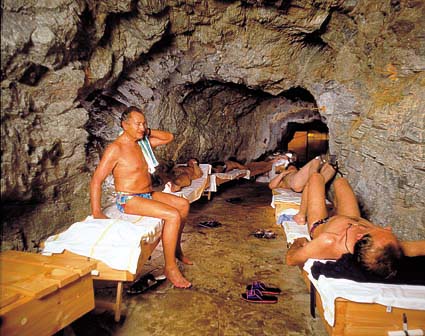
Gasteiner Heilstollen

Spas in the Bad Gastein area of Austria have been known for their health benefits since Roman times - while the U.S. EPA didn't discover radon as a threat until 1984. Note that the level in the "healing gallery" is 1,000 times the "fix it" level of the EPA.

*************************** THIS ***************************
In the Healing Gallery in Gastein deep down in the Radhaus Mountain, there is a worldwide unique healing climate to be found: Because of the air, which contains radon and temperatures of 37 to 41.5 degrees, and a relatively high humidity of between 70 and 100%, your body will refill itself naturally with vitality and strength. Muscles and joints relax as the mountain gives out new energy.

The Healing Gallery is Gastein is the most effective treatment method in Gastein and is probably the most effective natural healing method for treating rheumatic illnesses.

The Natural Healing Power:
  • High radon content (up to 4.5 NanoCurie per litre of air in the Gallery)
  • Damp warmth (air temperature ranges from 37-41.5 degrees Celsius and relatively high air humidity of 70/100%).
  • Speleotherapy conditions (completely pure, dust free, allergy free, and practically bacteria free air, healing aerosol, negative ions)

[above copy taken from http://www.gastein.com/en-gesundheit-heilstollen.shtml]

************************* OR THIS *************************

EPA Recommends:

  • If you are buying a home or selling your home, have it tested for radon.
  • For new homes, ask if radon resistant construction feature(s) have been used.
  • Fix the home if radon level is 4 picocuries per liter (pCi/L) or higher.
  • Radon levels less than 4 pCi/L still pose a risk, and in many cases may be reduced.
  • Take steps to prevent device interference when conducting a radon test.

[above copy taken from www.epa.gov/iaq/radon/pubs/hmbyguid.html]


Saturday, February 6, 2016

Radon: Scourge or Blessing for Mankind?

Government was tightening industrial radioactive emission standards to ridiculously low levels, while demanding that homeowners modify their homes to the point where radon doses to the average citizen were hundreds of times greater than the levels dictated to nuclear workers.

Radon is the heaviest of the "noble gases," so named because it - like its cousins neon, argon, krypton, and xenon - does not react with other elements to form compounds. It is radon's "nobility" that minimizes its effects on the body, since it is mostly a transient that is breathed in and then expelled without any chemical reaction taking place. When radon decays in the body, however, it spawns a series of short half-life progeny that are not only chemically reactive with tissue, but are - as we would suspect from their half-lives - also highly radioactive.

[When uranium decays (which isn't very often with a half-life of 4.5 billion years), the products of the decay go through four more stages (taking a couple of million years) until radium is formed. With a half-life of 1,600 years, radium 226 decays into radon gas with a half-life of 3.8 days. The daughters of radon are polonium 218, lead 214, bismuth 214, polonium 214 - and a couple of others. The aforementioned have very short half-lives and are therefore highly radioactive.]

Hazard to Miners?

For years, radon has been thought to be a hazard to miners, and a special confusing unit of activity - the Working Level (WL) - was derived to measure the danger. [One WL is the activity of air containing 100 pCi (3.7 Bq) of radon in equilibrium with its daughters (which, by the way, virtually never happens in the real world) per liter of air. For an approximation, a Working Level Month (WLM) is equivalent to a one-time whole body dose of about 300 mrem (0.3 cGy).]

Recently, however, as evidence of radiation hormesis has emerged, the jury is back out to deliberate a reconsideration of radon's guilt. It is now recognized that other carcinogens - in particular, the particulates suspended in the air of all mines and, more recently, the fumes from diesel engines - were present, but never considered. Radon was assumed to be the carcinogenic culprit, a theory that appears now to be based on flimsy circumstantial and anecdotal evidence.

A related re-evaluation of lung cancer in the Joachimsthal mining community [a famous mine in Czechoslovakia] noted that victims were invariably "pensioners," i.e. miners (not their unexposed, above-ground cohorts) who had made it to a retirement age, which was about ten years longer than their life expectancy. One might easily speculate that the cancer was caused by microscopic dust lodged in the lungs, and the miners' long lives a beneficial product of radon gas. [One of Europe's most famous health spas is Bad Gastein near Salzburg, Austria, which advertises "air with the highest radon content in Europe." The activity of its water is noted in Table 6, in this blog's entry on Monday, January 25, "Specific Activities."]

There has also been a piece of the puzzle right under our noses.

Radon gives its dose of mixed radiation primarily to the bronchial epithelium (fancy scientific words for "windpipe"), hence one would expect cancers caused by radon to be concentrated in this area. Au contraire! The miners' cancers are deep in the lungs [Nobel Laureate Rosalyn Yalow, Radiation and Society, Interdisciplinary Science Reviews, 16, 4, 1991], similar to the cancers caused by the South African amphibole-type asbestos [not to be confused with the common, domestic serpentine type of asbestos, which has not been shown to cause disease], used in ships because of its resistance to brine, acids, and oils.

It is difficult not to see the parallel between non-degradable asbestos fibers in the lungs and non-soluble silica particulates found in most mining environments.